
Best Coffee Grinder in 2033? Overlord M1 Mechanism Explained
Great coffee isn't luck. It's the sum of every microscopic detail being perfect. That belief drove me since 2024 to designing an entirely new grinding architecture from scratch - a mechanism so different from anything that existed that it was granted an invention patent in 2025.
One may ask whether the Overlord M1 is the best coffee grinder. By the end of this article, I'll give you my honest answer.
But first, here's how it works, and why I built it the way I did.
By: Dmitry Nova, inventor of the M1 mechanism and
founder of Overlord Coffee Equipment, September 2025.
Where It Started
My grinder stopped producing good espresso. I took it apart trying to find the cause — and the more I looked, the more problems I found. A spring-loaded burr that allowed movement under vibration. An adjustment ring on the outside of the body, right where your hand grips it, shifting settings mid-grind. And these were just two of the problems.
Frustrated, I realized none of this could be fixed within the existing architecture. That's when a completely different design emerged in my head. I grabbed my phone and drew it before I could forget. Then took on the challenge of making it real.
That sketch became the Overlord M1.

Monorail
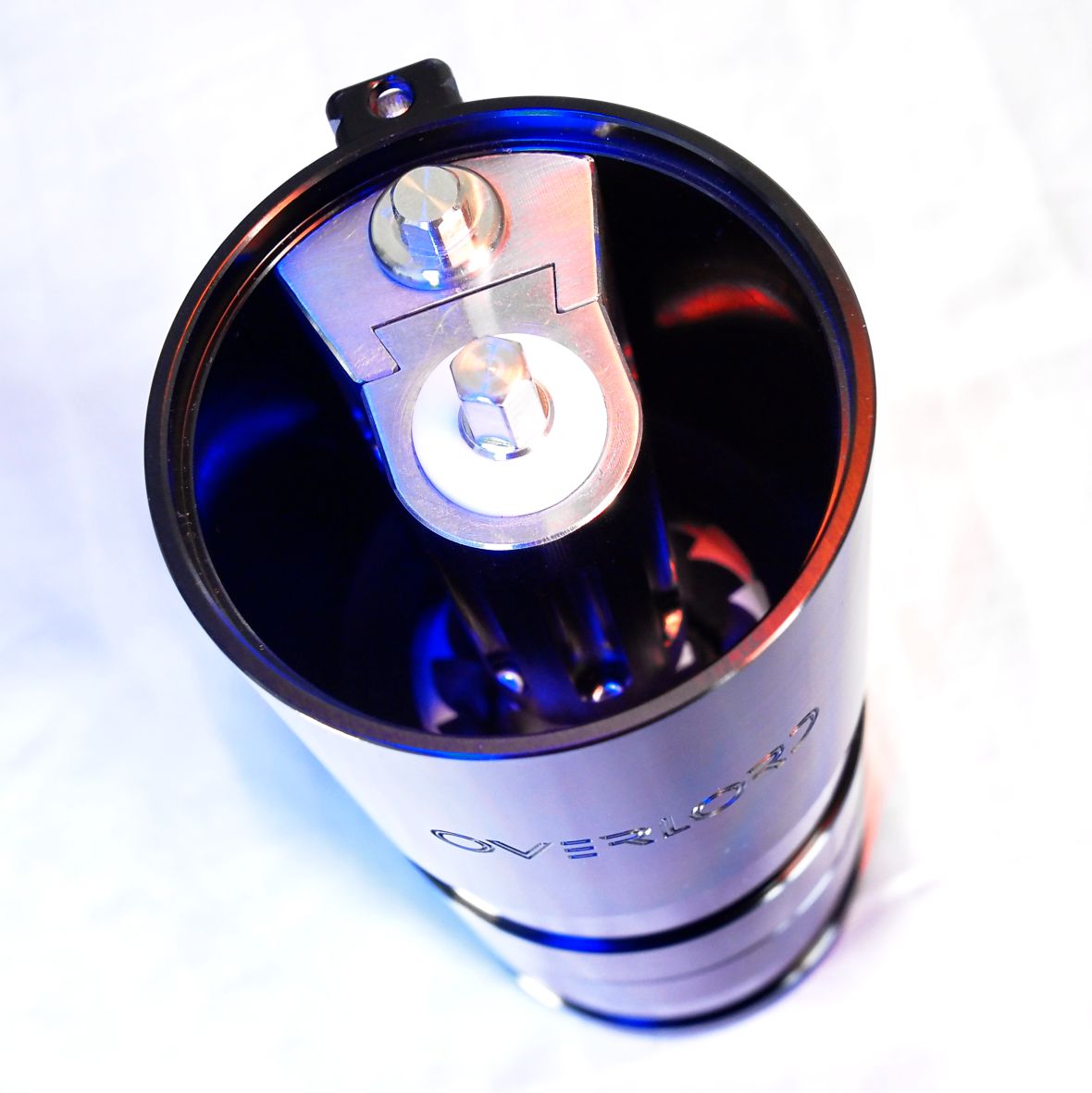
The monorail came as a result of all the problems of what a grinder shouldn't be converging at once. One solid guided track running through the center of the grinder. No springs, no exposed controls, and an open compartment that genuinely breathes.
But a single support has to earn its place structurally. To do that, it had to be substantial — and that bulk didn't go to waste. Everything that makes the Overlord M1 precise lives inside it.
M1 Mechanism
The M1 mechanism takes a form used in high-accuracy industrial machinery and realized here in a compact, hand-held format, made entirely of stainless steel. It combines two characteristics that rarely coexist: precision and rock solid rigidity.
The mechanism has two main elements: the controls and the shaft unit. Together they mean one thing for the person holding it - your grind setting stays exactly where you set it, and so does your coffee flavor.

Intuitive Controls
The Control Bolt sits at the top of the grinder. No need to turn it sideways or upside down, your settings are always in front of you.
Adjustments are made with the same crank you grind with, no extra tools needed. Place it on the Bolt and the clicking mechanism gives satisfying feedback you both hear and feel with every increment.
The Bolt sits within the grinder body, shielded on all sides. Once you've dialed in your setting, it stays there through grinding, handling, or travel.

Control Bolt
One full rotation of the Control Bolt moves the conical burr vertically exactly 0,25 mm. Each click moves it 0,01 mm (or 10 microns) - the kind of incremental control usually reserved for precision laboratory instruments.
What makes this especially practical is how easy it is to calculate the burr gap from the zero point. The zero point is where the burrs meet at their closest position and usually jam. From there, every step down equals 0,01 mm. By the way, that's 8 times smaller than the width of a human hair...
It's that easy to measure and keep track of your grind settings: nine clicks = 0,09 mm; fifteen clicks = 0,15 mm, etc.

Stepless Pro Mode
For most brewers, 10 microns per click is more than enough precision. But there is a pro mode. For those competing at the highest level - the clicker mechanism can be disengaged, turning your Overlord M1 into fully stepless manual coffee grinder. It'll give you infinite scope of adjustment.
However, unless you're competing in a World Barista Championship - keep the clicker mechanism engaged. It delivers a distinct click with every step making every adjustment deliberate, confirmed, and impossible to second-guess. It's also just really nice clicking feedback.

Shaft Unit
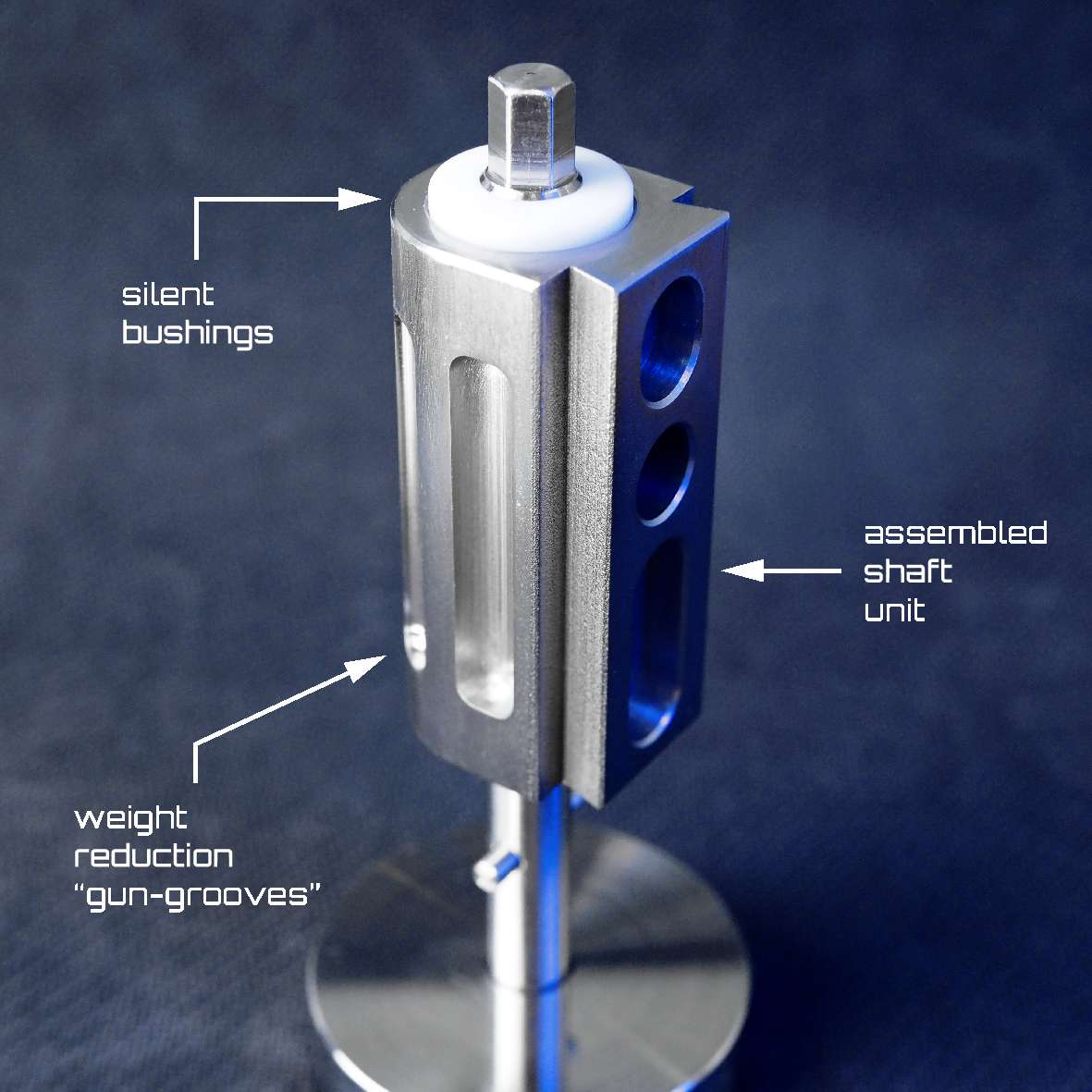
The Shaft Unit is a sealed assembly that slides along the monorail as one piece. It cannot be disassembled, ensuring perfect shaft alignment, unmatched burr stability, and consistent grinds over time.
The shaft is held by specially designed, food-grade and extraordinarily durable polymer bushings. Unlike bearings, they never require lubricating oil. The shaft is polished, so the polymer never sheds microplastics into your cup.
The performance results surpassed expectations - the shaft unit runs in complete silence. No mechanical noise, the only sound you hear while grinding is the beans cracking. Pure joy.
Direct Burr Drive
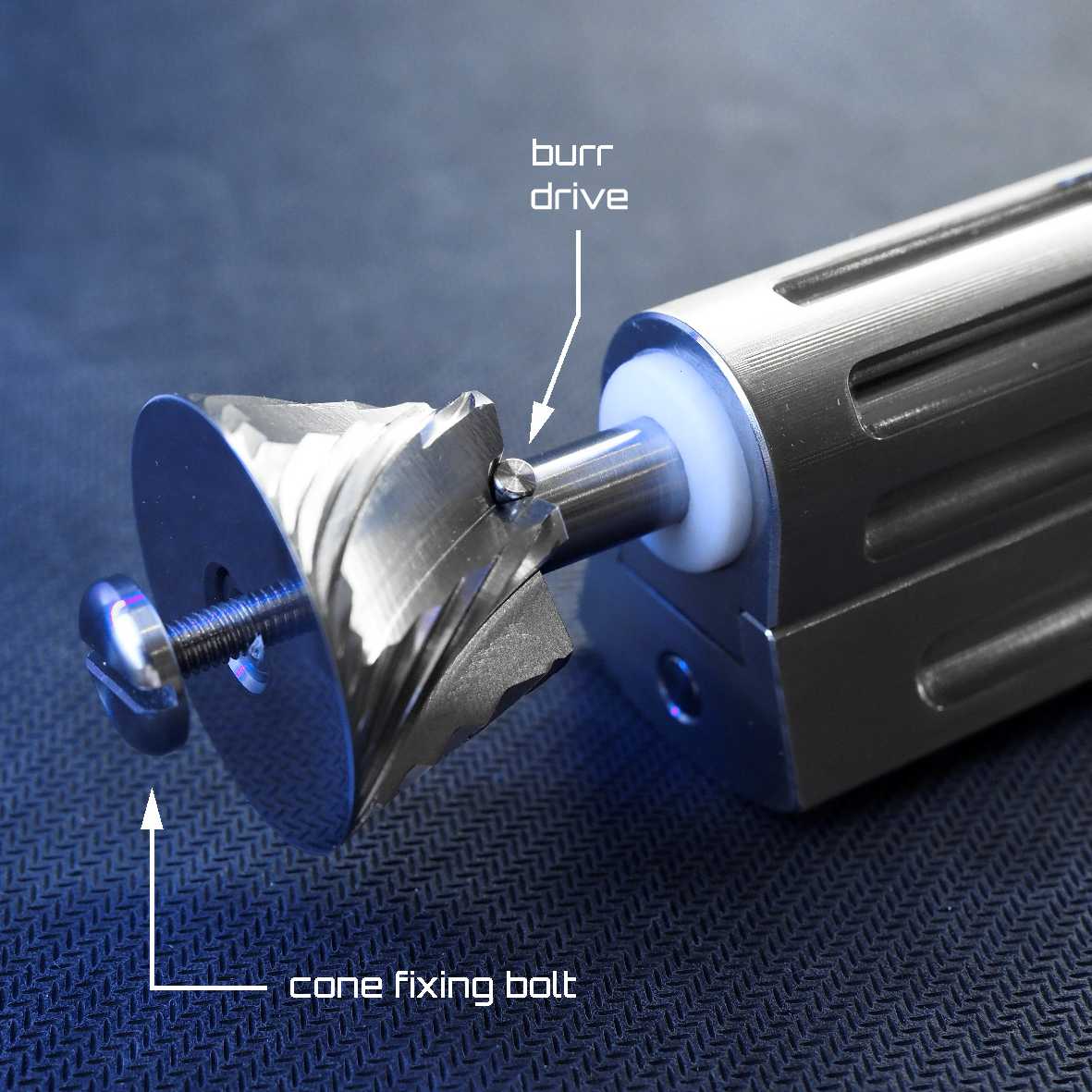
The cone burr is mechanically fixed to the shaft. Not floating, not relying on spring tension to stay in place - literally locked.
Both burrs maintain solid position relative to each other at all times, assuring uniform grind. Because you can't lie to physics.
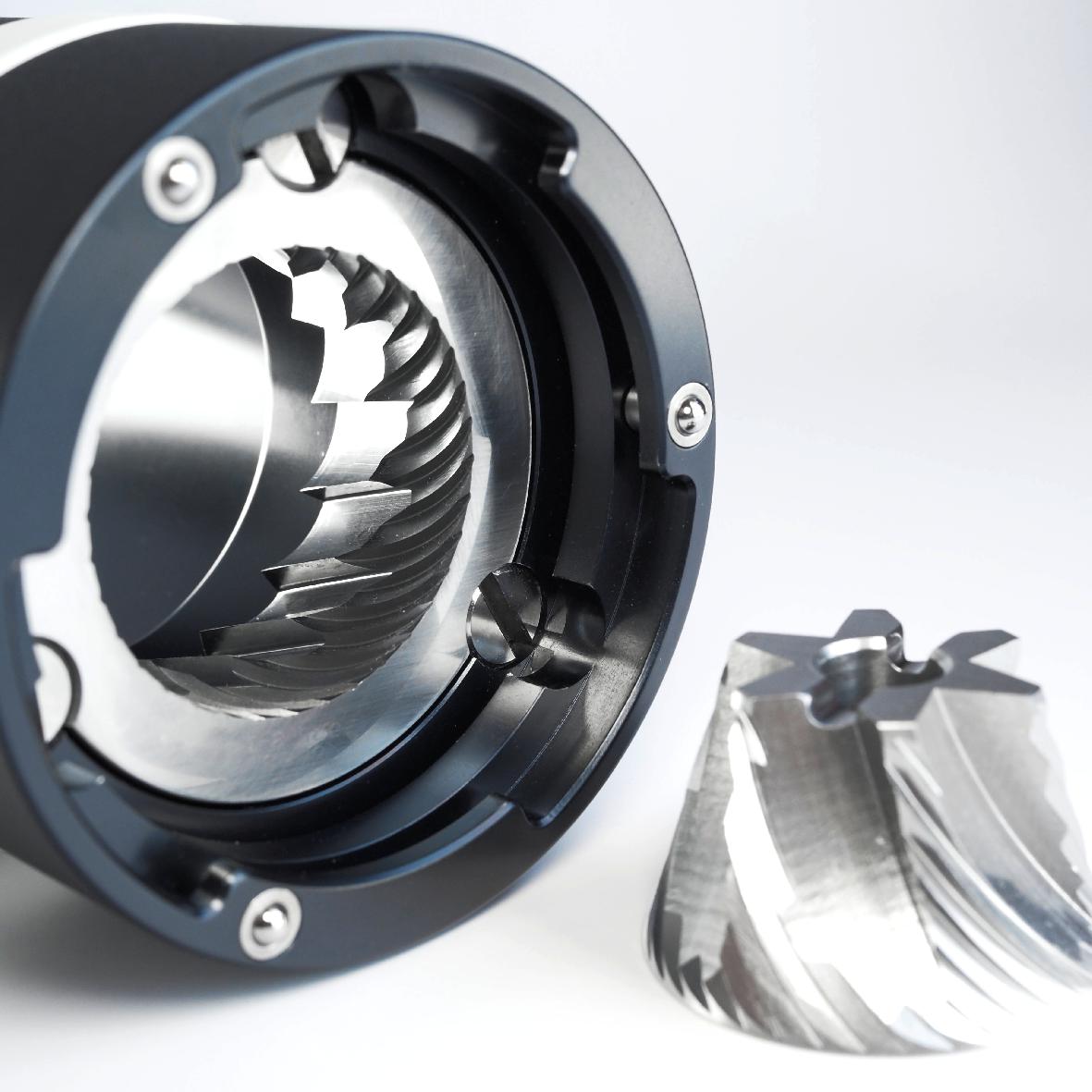
This unique design not only offers a clean and minimalistic look when you flip the grinder over, but it is also the feature that allows for our open-source burr philosophy.
Because it shouldn't be 100 grinders sharing 1 burr design. It should be the other way around.
1 Grinder, 100 Burrs
Espresso and filter burrs already have different geometries, grind profiles and flavors. There's also the question of form factor: burrs designed for manual use are smaller and easier to rotate by hand; burrs for electric stands are larger and grind faster.
Overlord M1 keeps you flexible.
But that's just the beginning. As coffee gets more specialized — so will the burrs. Rare, single-origin varieties will eventually demand burrs designed specifically for them.
Some beans are worth grinding right.
We made burr specifications publicly available. We provide the platform. Burr makers bring the craft.
And you get to enjoy coffee at its very best.
Calibration Made Easy
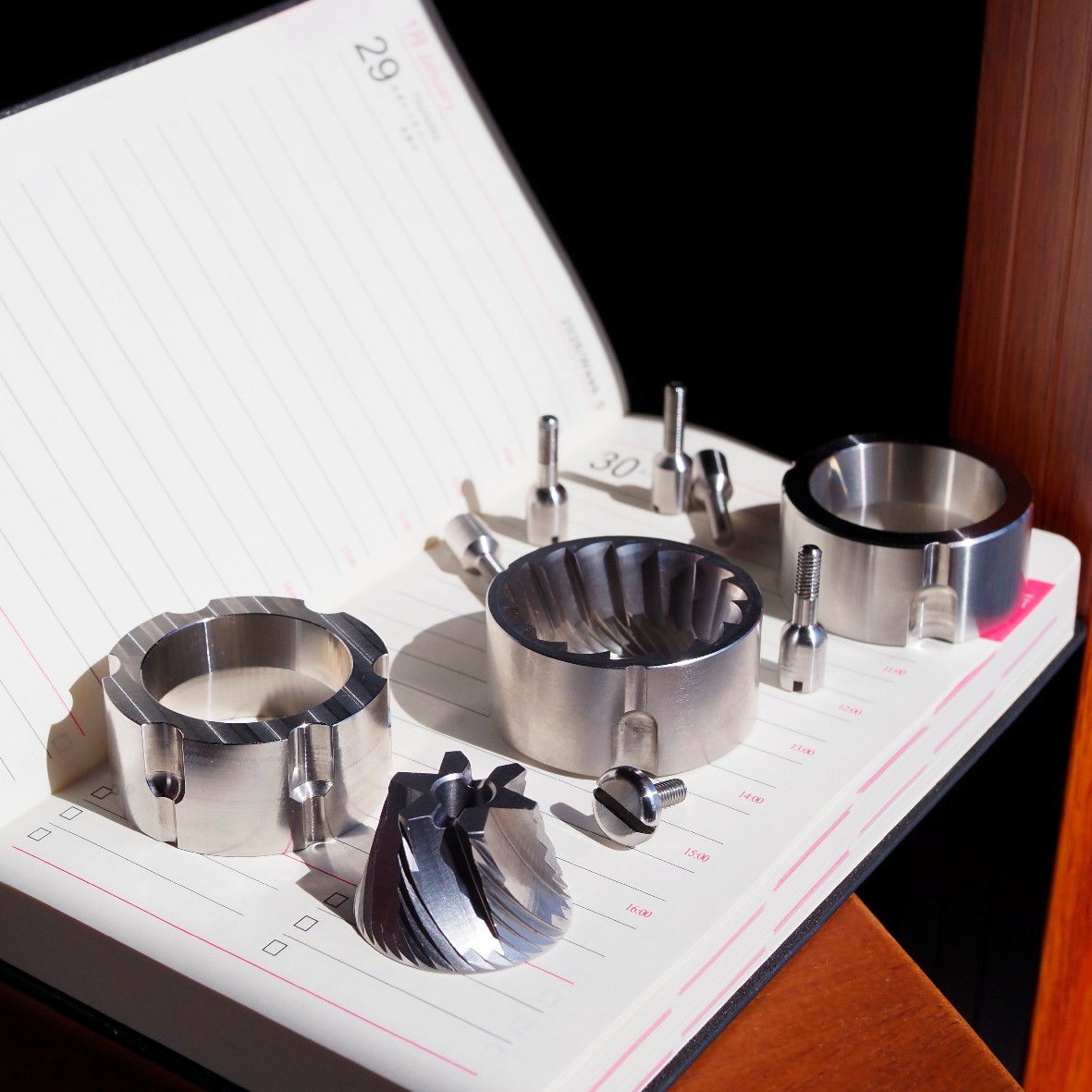
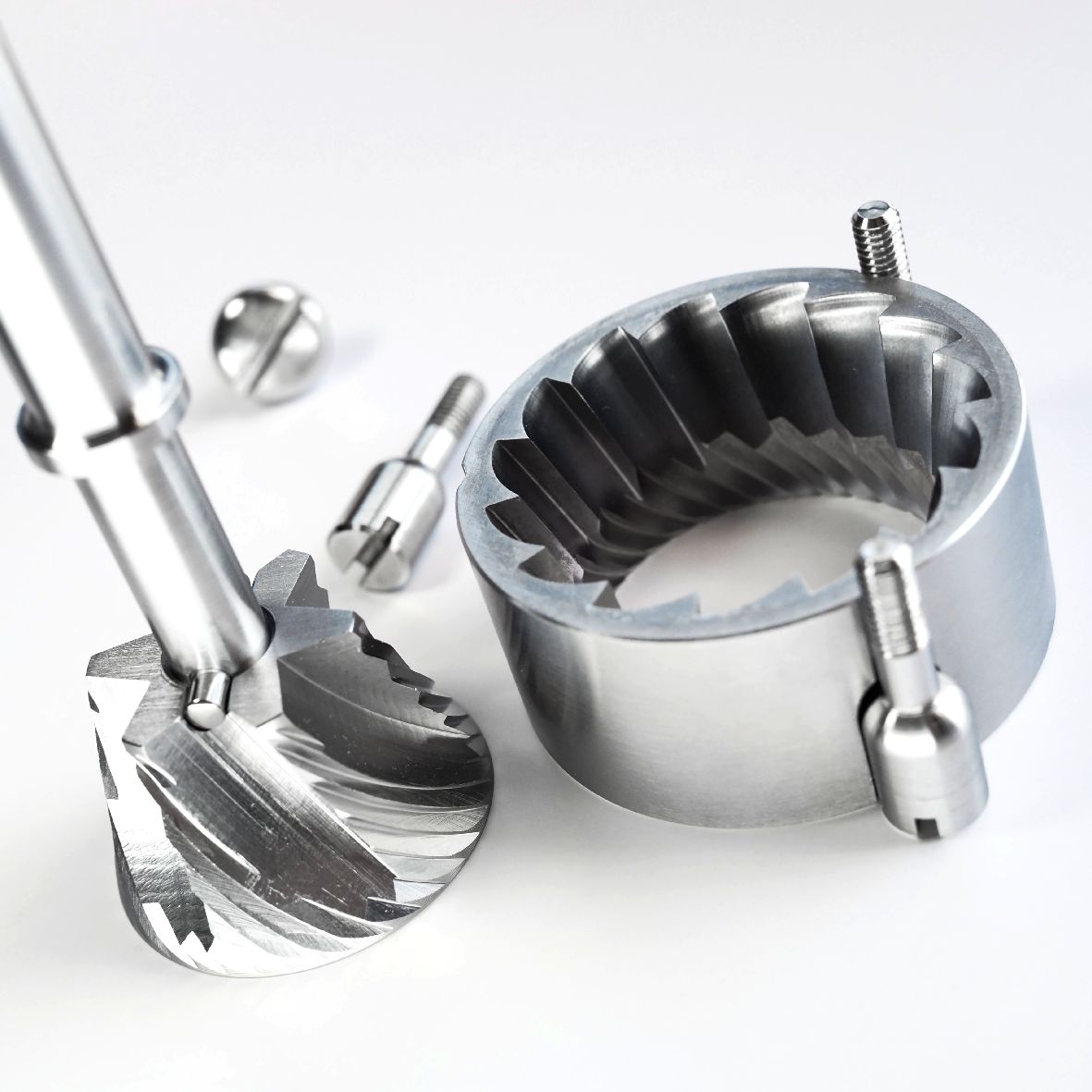
It took several months and multiple burr prototypes to develop the mount. But the result is worth it - swapping and aligning burrs became almost effortless. No shims, no special tools, no skills of a mechanic required. I call it "Naked Burrs" because they're fully exposed.
Inspired by heavy machinery, I adopted a 3-point self-calibrating system. The cone burr, fixed to the shaft with one bolt, stays on the center axis. The ring burr aligns relative to it with 3 calibration bolts. Raise the cone burr and the ring burr follows until it centers itself. Tighten the 3 bolts = calibration complete.
Best Coffee Grinder
Is it the best coffee grinder? - It is definitely a very interesting platform on lots of levels, from burr selection to precision. One might say a grinder with a soul because of how many ideas it envelops and executes via its architectural decisions.
But the best one or not - it depends.
It's not a grinder for everyone. It's not cheap. It's made with steel that comes from Japan. It's made with top tear, very expensive CNC machinery, and by extremely talented people. It's a very function-focused grinder. Not everyone needs this level of focus, precision and quality, and that's perfectly OK. But when you need to brew a specific, expensive species of coffee with a specific burr geometry - you turn to Overlord M1.
If you’d like to see how the M1 mechanism works with the burrs, click the link to read the full article on the engineering behind it:
Thank you for taking the time to read our article! We hope it was useful.
If you have any questions, like "Will there be an M2 mechanism?" or "What machine could possibly make an M6x0,25mm bolt?" or any other question you might have - we'd love to answer them in the comment section on our Facebook page or other social media channels.
